The Origin,
Variations & History of the Callaghan Surname and Clans
(featuring the
exploits of Ceallachán of Caisil and his clan)
Note: For the “Callaghans of Munster” clan pages,
visit www.ocallaghanclan.org
Origin and Variations of
The Callaghan Surname & Clans
The English
term Clan is derived from the Gaelic word Clann, meaning ‘family’ and includes those
adopted into the clan (ie via strategic alliance, adoption, marriage etc)
making membership not solely a matter of DNA (1).
Historically, it is believed that there were four main distinct Irish clans
who, those bearing the surname derived from Callaghan (or one of the
other variations, see further down), originate from. These clans were
located in the areas of Donegal, Mayo, Munster and the ancient kingdom of Oriel
(Armagh, Louth, Meath, Monaghan), with each Clan having their own founding
figure. With the advent of DNA testing, clan research is rapidly progressing(2).
For example, some researchers argue that Y-DNA is revealing there may be as
many as eleven distinct Callaghan clans.(3) although,
as stated above, clan membership is not solely a matter of DNA. According to
the Council of
Irish Clans, originally a clan referred to the immediate family of a
chieftain but quickly extended to include the wider family. Over time, it
spread to include people who were not genetically related but who, at some
point in time, had adopted the surname to signal allegiance to the community
with whom they shared common territory, culture, and symbolism. Thus, modern
clans, are more complex than simply shared Y-DNA(4).
In the case of
Callaghans (including all the variations of the surname), arguably the
most famous of these Callaghan clans was that led by Ceallachán of Caisil, the name of the
formidable Chief of the Eóganachta tribe and King of Munster (what is now
counties Clare, Cork, Kerry, Limerick, Tipperary & Waterford in Ireland)
from AD 935 until 954 who, amongst many other famed
accomplishments, is said to have defeated the father of Brian Boru of the Dal
gCais in battle and subdued the Vikings, capturing amongst his many conquests, Caisil (now known as Cashel in Tipperary), the historical capital of
Munster, leading to him being assigned the name Ceallachán of Caisil or more simply, Ceallachán Caisil (see “Book of
The Callaghan” by Chris O'Callaghan). Ceallachán is thought to be a diminutive form of the Gaelic word Ceallach, the origin of which is
unknown, but suggestions for its meaning(5) include bright-headed (as a personal name) or strife/war (in the sense of fight or
contention for superiority).
Ireland spent
much of its life occupied by foreign powers who anglicised Irish names giving
rise to many variants. Moreover, the lack of standardised spelling (the first
dictionary, written by Robert Cawdrey, wasn’t published until 1604!)
meant the process of converting what may be identical oral sounds into written
words, inevitably lead to the generation of numerous variations, which is
immediately apparent when reading old texts and translations, where different
writers, at different times used different spellings to describe the same Callaghan
ancestor. Added to this, Irish names contain many prefixes(6)
and silent letters that clerks of occupying powers, or those involved in
immigration procedures, would often drop somewhat randomly. These actions also
created multiple alternatives of surnames. In the case of Ceallachán this gave rise to versions such as Ceillacháin,
Ceilahan, Callachan, Calachan, Ceilaghan, Ceallaghan, Cellachain, Cellachan,
Cellaghan, O'Callaghan, Callaghan,
Callahan, O'Callahan, Calahan, Callagan, Calagan, Callighan, Kalahan,
Kallaghan, Kallahan, O'Kallaghan, Kellaghan, Kelleghan, Kellahan, Kelahan,
Keelaghan, Kealahan & Keelan. Some variants of names can be related to particular
septs as, for example, Ó’Ceillacháin is especially
popular with septs found in the Irish counties of Armagh, Louth, Meath and
Monaghan whereas, in Munster (counties Clare, Cork, Kerry, Limerick, Tipperary,
Waterford), Ceallachán is favoured
over Ceillacháin. Some people have
suggested Ceallachán is a more direct ‘mapping’ of the name
to the ancient king, while others argue that the spoken sound of Ceallachán
better matches the variants of 'Callaghan' found in Munster. Of course,
for those outside the Callaghan fraternity these details are less important
which sometimes leads to inconsistency in usage, especially with the Irish
forms such as Ceallachán and Ceillacháin. Also, it should be noted
that, whilst the author of this website is using his own family’s surname,
there will be other variations of the name which are rooted in the same genes.
Thus, for example, if your family name is Callaghan, don’t limit your
search to only this spelling, as you will miss some excellent sources of
additional information, such as the Callahan surname website(7).
After Ceallachán of
Caisil
Hereditary
records(8) place the original location of the Ceallachán of Caisil sept as being
in the Barony
of Kinalea, a strip of coastal
land in County Cork, between Kinsale Harbour
and Cork Harbour, an area
they lost during the Anglo-Norman conquest under Strongbow (12th
century) causing them to relocate to the vicinity of Mallow in the North of
the county (with their main strongholds being castles at Clonmeen
and Dromaneen,
near the present day village of Banteer).
Here they experienced some four centuries of dominance, enjoying many earlier
Gaelic customs such as the creach or
cattle-raid; one chief of the Callaghan
family (Donncha O'Callaghan, 1537-1578)
was reputed to have conducted more than two hundred raids across Ireland. They
remained in Cork until the Cromwellian plantation period (and the Irish
rebellion of 1641) where, following the final surrender of 1652,
they lost their ancestral lands and were transported to the barony of Tulla
(East Clare) where, name places (eg Callaghan Mills) and modern Y-DNA testing
(eg FamilyTreeDNA), testify to the past and present concentration of
descendants of the Ceallachán of Caisil clan in the area. In further
testament to those troubled times, just prior to being forcibly evicted from
their Cork lands, it is reported that at least seventeen Callaghan’s had been
declared outlaws! 20,000 acres (of 24,000 acres) confiscated from the
Callaghan’s were recorded as belonging to one Donncha O'Callaghan, making him the most important Callaghan at that time to be
dispossessed of property. It seems that other members of the sept either
remained as tenants of the newly installed English owners or fled to Europe.
Interestingly, the Dublin Genealogical Office (in 1994) supported Don
Juan O'Callaghan of Tortosa, Spain, in his claim to be the closest modern male
descendant of Donough O'Callaghan
adding supporting evidence to the exodus of many Callaghan’s to Europe during
the turbulent years (giving rise to the oddity that the surname Callaghan is a reasonably well known in
Spain!). In more modern times the descendants of the Callaghan sept have joined the broader Irish diaspora, being found
in almost every country of the world. Meanwhile, back home in Ireland, and in
an interesting twist to the Callaghan story(9), the 20th
Century, saw a branch of the Callaghan
family returning to live in the ancestral land they were evited from in the mid-fifteenth
century! Talking of miraculous things, apparently there was a Saint Callaghan, or Ceallachán, who was a monk at Clontibret (County Monaghan, Ireland)
with a feast day of the 24th of September.
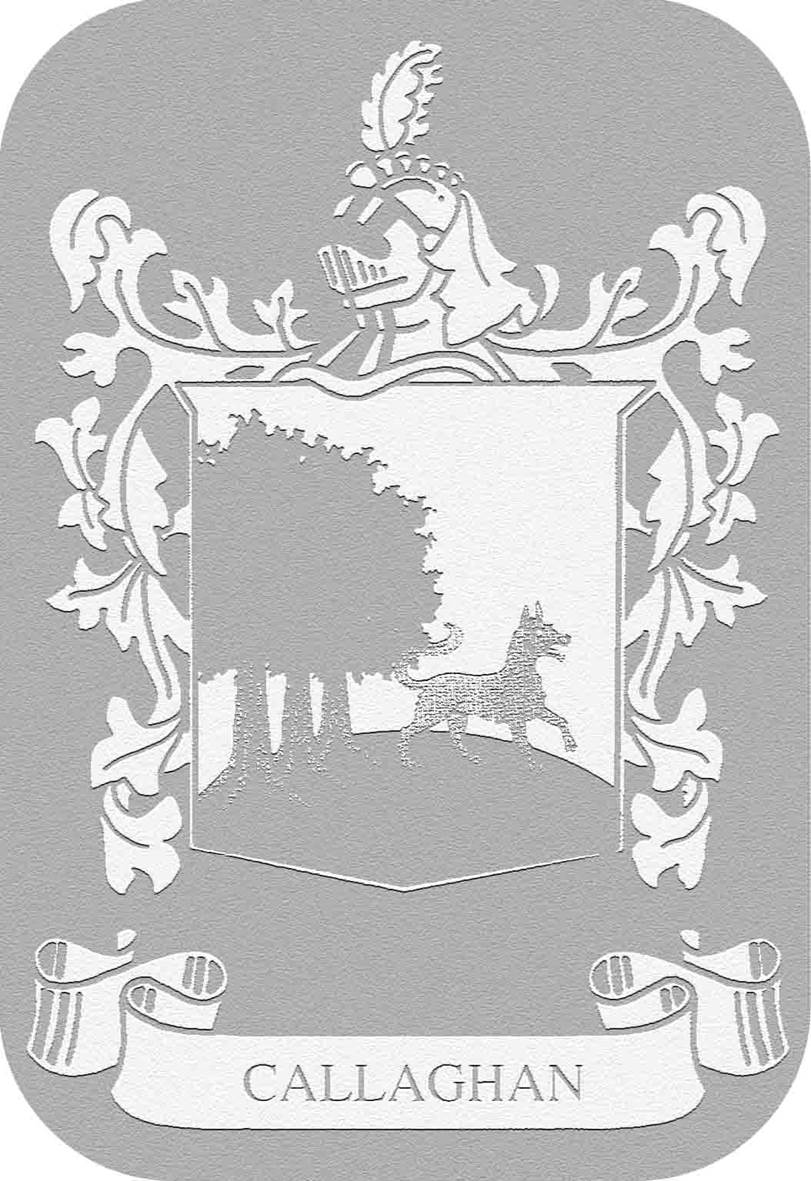
The Callaghan Coat-of-Arms
A digital
illustration of what many historians argue is the original format of the
Munster based O’Callaghan Clan Coat-of-Arms, is displayed at the top of
this page (this will be discussed in greater detail in the following
paragraphs). For those of you who have purchased plaques bearing the Callaghan
(or one of its numerous spelling variations) “Coats-of-Arms”, for proud display
in your homes, you will immediately see how minimalist and much less ornate the
above version is! It seems that, as the use of these arms has moved from the
battlefield to the walls of our homes, they have become ever more ornate.
However, before we dive deeper into the history of the Callaghan Clan
Coat of Arms, let’s explore its meaning.
On 23 Dec 1944,
shortly after the “Office of the Chief Herald of Ireland” was
established (1943), a description of the O’Callaghan Coat of Arms was
certified as being:
Argent
in base a mount vert, on the dexter side a grove of trees, therefrom issuant a
wolf passant towards the sinister, all proper. For the Crest: A dexter hand
couped at the wrist holding bendwise a sword entwined with a snake all proper
and for Mottoes: “Fidus et Audax”and “In Virtue Vincere”.
This description had been submitted to the “Office of
the Chief Herald of Ireland” by Juan
O’Callaghan Martinez
(descendant of the O’Callaghan Clan leadership who fled to Spain after
the Cromwellian plantation of the 17th century), as part of his claim to
be “Chief of the Name” of the O’Callaghan Clan. In terms of the meaning of the arms description, ‘dexter’
and ‘sinister’, are Latin for ‘right’ and ‘left’. However, in
heraldry, references
to right (dexter) and left (sinister) of a shield, refer to the viewpoint of
the shield bearer and not the viewer, where these
perspectives would be reversed(i). ‘Fidus et Audax’ means ‘Faithful and Bold’, the widely
recognised motto of the Callaghan Clan (‘bold’ meaning ‘strong’
or ‘strong willed’). ‘In Virtue Vincere’ means to ‘Conquer in Virtue’, and
is a less recognised motto for the Callaghan
Clan, which
might be because it is more personally associated with the family of Juan
O’Callaghan Martinez, who registered these arms (see next paragraph). Concerning the image on
the arms, the widely agreed explanation is that the oak trees represent the forest which played a role in
the inauguration of Ceallachán as king (e.g. were a backdrop to the scene).
Additionally, in heraldry, Oak trees are commonly associated with stability and
endurance, plus they have a special place in Irish folklore (especially
folklore rooted in druidic pagan Ireland) where they represent a connection between
the real and otherworld. In heraldry, wolves are considered to be noble and courageous animals.
In connection with the wolf depicted in the Munster Callaghan clans
coat-of-arms, the historian Joseph
O’Callaghan makes reference to the Gaelic poet, Aodhagán Ó
Rathaille who, in 1726 spoke of “a wolf, fierce, violent, impetuous/
Issuing from the wood’s border in rapid race/ And going forth to hunt in the
plains of Fodla”. The Plains of Fódla, are said to be located somewhere in
the area of the Slieve Felim Mountains in County Limerick. These plains are
significant in Irish mythology and history, being called after the mythical
goddess Fódla, who, along with her sisters Banba and Ériu, represent the sovereignty
of Ireland. Finally, in Irish heraldry, a snake around a sword symbolizes wisdom
and fertility, as well as the banishment of evil, echoing the
legend of St. Patrick who is said to have chased away snakes from Ireland. In
the case of the Callaghan crest, the triumphant armoured hand, holding
aloft a sword with a snake entwinned on its blade, is often interpreted as
emphasising the latter. In particular, Ceallachán was seen by history, as banishing the evil of
Viking subversion from Munster plus, his Christian roots, resonate with the
tale of St Patrick.
So, what is
the history of Irish Clan Coats-of-Arms? Coats-of-Arms are thought to have
originated after the Norman invasion in 1169 to distinguish between “friend
and foe” on the battlefield, when people’s features were obscured by armour
(in much the same way as modern uniforms or flags work). By the 13th century,
Coats-of-Arms became hereditary, featuring unique designs representing
individual clans. It is important to note that the practice of Irish
heraldry differs to that of England in one very important way, in the Irish
Republic, clan
arms belong to descendants of a clan rather than individuals! This rule,
along with the ingrained nature of clans in Irish families, has resulted
in clan heraldry remaining a visibly popular part of Irish culture, unlike
other countries where it is seen as archaic or elitist. Initially, the practice
of heraldry was unregulated, with clans doing as they liked. However, in 1392
the first herald of arms for Ireland was created followed in 1552, by
the introduction of a single Ulster based official body for the whole of
Ireland, the Ulster King of Arms. In 1943, well after Ireland had
achieved independence, the Irish Republic created its own “Office of the
Chief Herald of Ireland”, to oversee its heraldry, which the above
description of the Callaghan Clan of Munster Coat-of-Arms was taken
from.
So, lastly, is there any
supporting historical evidence for the design of the Munster Callaghan’s
Coat-of-Arms, before its official entry
into the “Office
of the Chief Herald of Ireland”? In his book, Clan
Callaghan; The O’Callaghan Family of County Cork, the
highly-respected historian Joseph
O’Callaghan refers to the Royal Herald, James Terry, who In 1723, at
the request of Mathew O’Callaghan a captain in the Spanish service, described
the family coat of arms as being: “on a silver shield issuing on the left
from a green wood, a wolf, in its own colours”. Moreover, Joseph
O’Callaghan
describes a monument erected in Clonmeen Church in 1735, by
Cornelius O’Callaghan, which was surmounted by the same coat-of-arms as
above, together with a motto “Fidus et Audax” which, Joseph
O’Callaghan
suggests, is the first known record of the O’Callaghan motto. Note that 1)
Clonmeen Church suffered significant ravages of time, becoming dilapidated
by 1837, with the Callaghan arms and motto being no longer visible and
2) Clonmeen Church and the Cornelius O’Callaghan Mausoleum are
different buildings about 61Km apart, in Cork and Tipperary respectively, the
latter was built in 1742, containing its own inbuilt monument to
Cornelius O’Callaghan(j). More evidence of the coat-of-arms
design comes from a 1740 mezzotint portrait of Cornelius O’Callaghan,
painted by John Brooks and which can be seen in Dublin’s National Portrait
Gallery. It includes a depiction the same coat-of-arms, but viewed from the
viewers, rather than the bearers perspective(i). Somewhat
later in time, John Rooney’s 1895
book, “A
Genealogical History of Irish Families”(d) provides
further support that the above design is correct. Finally, all the above designs are consistent
with the
description in the “Office of the Chief Herald of Ireland”, entered by
Juan O’Callaghan Martinez (The Chief of the Name) in 1943 (and as
illustrated above).
More Recent Callaghan Generations
The
first written record of the name Callaghan (with that particular
spelling – ie the most widespread anglicised version) is held in the Birth Records of County
Cork, dated 1605, for one John O'
Callaghan. In
the 2011 census, the total number of people bearing either the name
O'Callaghan or Callaghan in Ireland was of the order 13,000 (not as large as
you might imagine!), but it still placed the name in the top-40 of Irish
surnames in use. So, what have the more
modern members of the Sept been doing? You need only type “Callaghan”
into a search engine to be flooded with pages relating to more modern
Callaghan’s, and their impressive exploits. As you would expect, Callaghan’s in
the public eye are returned in the first pages of search engine results,
featuring the likes of the former British Prime Minister, Leonard James (Jim)
Callaghan, William (Bill) O'Callaghan, an Irish senator, George Astley Callaghan, a British Admiral of the
Fleet, Callaghan,
Governor of several British colonies including the Falkland Islands, and the
Bahamas, Ian Robert Callaghan, a professional English
footballer who holds the record for most appearances for Liverpool FC, Bill O'Callaghan an Irish hurler who played
for Cork, Tommy Callaghan a Scottish professional
footballer who played for Celtic, and Georgina Callaghan, the English born singer
& songwriter, better known by her show-business name of “Callaghan”
who resides in the USA. This small
sample shines a light on the impact and spread of the Callaghan Diaspora,
or perhaps it says more about possible bias in Internet search engines! Whatever, these are just
the tip of iceberg of the international Callaghan family, as you will discover
should you search the web yourself. You will find URLs ranging from personal
pages, through general lists such as Wikipedia’s “Notable-Callaghan’s” to more specialised lists
such this web sites “Callaghan’s in Academia”. Just thirty minutes of
web searching will take you on an inspiring journey to meet the global
Callaghan family!
The Future of The Callaghan
Clan
The world has moved on from the
distant days of history, when clan membership was strategic to one’s everyday
survival (eg protecting us from death or slavery!). Notable changes began after
the long and ferocious Tudor
conquest of Ireland which included the ‘Nine Years War’ (1593-1603),
witnessing the destruction of the Gaelic aristocracy, the dissolution of Irish
clans and the and the Flight of the Earls (1607). This was
followed by the commencement of mass emigration in the 18th century, the Great
Famine in the 19th century (1845 to 1855) all of
which eventually led to (in 2020) some 80 million people worldwide
claiming some Irish descent!
The
Callaghan’s were part of this exodus from their homeland, leading to a
significant Callaghan diaspora being
scattered around the world. So, a natural question is, what does carrying the
genes of the Callaghan Clan mean to this modern generation, apart from
historical knowledge and a plaque on the wall displaying their clan
coat-of-arms? There remain a number of organisations working to preserve Irish
clans (eg the Council
of Irish Clans & Clans
of Ireland), along with their heraldry (eg The Office of the Chief Herald of Ireland, and ‘College
of Arms), but the truth is that only a tiny fraction of Irish clan members
actively participate in clan related activities! This is generally explained by
changes in society making the role of clans less relevant to the modern
generation (eg they no longer protect us from death and slavery!), together
with people having increasingly busy lives! Moreover, it seems that some people
are put off by, what they interpret as pretentions of an Irish aristocracy,
involving heraldry and inheritance of title (with occasional infighting for the
honour!), while others are drawn to this, as a portal into their past. Thus,
you could reasonably ask, what is the role of Irish Clans in the modern world?
Are these organisations, at best, simply custodians of history and tradition,
or can they offer their modern descendants’ tangible benefits and a reason to
be active participants? This is not a question to be answered here, but rather
a question for those of you who have inherited the genes of an Irish clan. If
you are interested in this topic, then visit one of the online Irish Clan
discussion forums, such https://www.ocallaghanclan.org.
As for the long-term future of Irish clans, as the saying goes, only time
will tell!
Some Words of Caution!
First, don’t
confuse clans with race. Irish Clans originated from many differing races who,
at some point in history, came to Ireland, and over time melted together to
make the Ireland we see now(10). Second, when studying the
history of times long gone, both written and oral, remember that many of the
stories come from a very misty past, so they are not without contention (none
more so than names). Therefore, it is not surprising that scholars (and others)
take various positions, according to their interpretation of the fragments of
the past that have survived, but. the reality is that what truths may have
existed, are now somewhat obscured by mists of history and so, in many
respects, legends and facts will probably always be inseparably intertwined but
hopefully that will not diminish their value in our lives! Remember, by living
your life, you are writing your own chapter in the never-ending story of your
clan or family history …. so, make it a good chapter!
And Finally ……..
Remember, if you bear the name Callaghan (or one of its many
variations), or perhaps have ancestors that bore the name somewhere in your family tree, then
you are joined to a fraternity whose shared genes or spirit drive the dreams
that make us who we are, and who we will be; while we may never meet, we are
all part of a great adventure whose story is still unfolding :-)
Notes:
(1) Historically, a clan
issurname. Commonly, these
clans were clustered around distinct area in Ireland. In modern times, these
clans are represented by The
Council of Irish Clans, an international organisation which
promotes and celebrates Irish clan culture by providing a forum for Irish-clan
networking and cooperation.
(2)
Using
Y-chromosome data from bearers of variations of the Callaghan surname, enables researchers
to identify clusters of genetically closely related males, thereby illuminating
hitherto hidden information about clan membership. One excellent example is the
“O'Callaghan/Callaghan/Callahan/Keelaghan
Project” project organised by Brian Callahan on the FamilyTreeDNA website, a
company who provide a DNA testing service that is popular with those of Irish
descent.
(3)
IrishOrigenes “estimated that there are at least 11
genetically distinct Callaghan clans, 3 of which are located within Munster”.
While there methods are undoubtedly bringing a fresh perspective on genealogy
analysis, there are critics of their approach, as this Reddit
Review illustrates.
(4)
What is a Clan?, According
to the Irish Council of Clans, the English word clan derives from the Gaelic word clann, meaning ‘family’. In
brief, a clan can be perceived as a group of people who are united by actual
or perceived kinship and descent (for further discussion, see the Irish Council
of Clans and Wikipedia web pages).
(5)
Concerning the meaning of Callaghan, another view is that it was
derived from or
"frequenter of churches"
(6)
Prefixes to Irish names are
formed as follows; Bean Uí means wife of, ní in a girl’s name means daughter
of, and ó means descended from (eg grandfather or
earlier ancestor). That said, the “O”
in Irish surnames was frequently dropped to simplify official record keeping
(especially when immigrating to countries like the USA where clerks frequently
dropped the “O” prefix which, in
their eyes, complicated alphabetical filing!).
(7)
The
Callahan Genealogy and History website
managed by Kevin Callahan is full of useful material including information
about books, history, maps, photos, paintings and reference materials.
(8)
Hereditary surnames are
said to have been introduced to Ireland sometime after 1100. For
example, in the case of the Callaghans, Murchadh Ua Ceallachán who lived in
the early eleventh century, and a grandson of the original King Ceallachán, was the
first to transit the surname hereditarily.
(9)
After the Ceallachán/Callaghan sept forfeited
their Cork land (near Mallow) it was taken over by the Longfield family who, in
1720, built a grand house on original Ceallachán/Callaghan land. Reinforcing
the vigour of these changes, in 1795, Richard Longfield became Baron
Longueville. Interestingly, The Longfield family who maintained they were of French
extraction and not Cromwellians. However, in a twist of fate,'Longueville
House' and land was returned to the Callaghans in 1938, when it was
purchased (from the Longfields) by Senator
William O'Callaghan whose son Michael and wife Jane opened it to the public
in in 1969 as a simple Bed & Breakfast. The family are direct descendants of Donough
O'Callaghan who fought in 1640
rising. Later,
their eldest son William, with his wife Aisling, began running it as a luxurious
guesthouse, with William (Bill) O'Callaghan acting as head chef in its highly acclaimed restaurant, specialising in
'field-to-fork' food (food from its working farm). However, in a second
cruel twist of fate, a second foreign invasion, this time the Covid-19
virus (originating in sought to evict a
Callaghan family from their forefathers’ lands, resulting in the 400-acre
estate being placed
on the market for some €7m in
July 2022. At the time of writing (2025),
it is understood that the property is currently leased to a company, Earlsline Ltd,
for five years. In
June 2024, at a briefing
to local TDs, the Irish Department of Children, Equality,
Disability, Integration and Youth confirmed that more than 100 refugees were to
be housed in Longueville House. Just like the times of Donough O'Callaghan, change is in the air, and this age-old saga still has plenty of time
to throw up yet more twist of fate!
(10)Dr. Lara
Cassidy, an expert in ancient DNA based at Trinity College
Dublin explains, as part of the fascinating and highly recommended 2022
documentary Tomb
Raider, “Race is not a genetic concept it's not a biological concept
it is a social construct. People sometimes think that genes or genetics are a
more fixed anchor of identity than say a culture or a language. We know culture
and language changes all the time but so do genetic populations they're
ephemeral, they're fluid, they're changing, their boundaries are fuzzy and
people are always moving, they're migrating meeting and mixing.”
Some Additional
Sources of Information:
a. Chris
O'Callaghan “Book of
The Callaghan“, 396 pages,
Co. Cork, Ireland, 2013, 2014, 2017 & 2020,
ISBN: 978-0-9565354-2-9 - The first
in-depth factual account of Ceallachán of Caisil, the formidable Chief of the Eóganachta tribe and King of
Munster during the period 934-954. The book details 6 years of research to
reveal a successful and popular king whose legendary exploits have given him a
special place in Irish history. Chris has generously made a free digital
download version (pdf) of his book available on his web
pages.
b. Joseph
F.O Callaghan, "Clan Callaghan: The O Callaghan Family of County Cork", 302 pages,
publisher Genealogical.Com, Inc, published 23 Nov 2020 (revised edition), ISBN:
9780806359168, 2020 (revised) - A
well-researched book that traces the O'Callaghans (and variants of the name)
from their beginnings in Munster Ireland through the upheavals of history which
have seen their progeny scattered around the world.
c. Ceallachán
Caisil- web page discussing Ceallachán mac Buadacháin,
the 42nd Christian King of Munster 934-954
d. John Rooney, “The
O’Callaghan Family” one of the entries in
John Rooney’s 1895 publication “A
Genealogical History of Irish Families with their Crests and Armorial Bearings”. This publication, now hosted by Library
Ireland, has almost 500 entries giving
Irish family origins, meanings of ancestral names, descriptions of clan
territories, crests and armorial bearings.
e. Wikipedia
Entry - O'Callaghan
f. Edward MacLysaght, "Irish Family
Their names, Arms and Origins", Irish Academic Press, 1957, 1982,
1991, ISBN 0-7165-2364-7
g. Notable Callaghan Web lists
– “Wikipedia’s
Notable-Callaghan’s” and The Callaghan Clan’s “Callaghan’s in Academia” website.
h.
The O’Callaghan of Munster Clan Society web page - an online
society for people who, somewhere in their ancestry, share the surname O’Callaghan,
or one of the numerous modern variants and who can trace their Callaghan lineage
back to Munster in Ireland (ie counties Clare, Cork, Kerry, Limerick, Tipperary
& Waterford)
i.
Dexter and Sinister – A
Wikipedia explanation of the terms dexter and sinister in
heraldry
j.
Robert O’Byrne – An August 2023 blog entitled “Shabby
Treatment” showing photographs of the derelict O’Callaghan Mausoleum,
located in the Shanrahan Graveyard in Clogheen, County Tipperary which, sadly,
at the time, was being used to store garden tools!.
Constructive comments are welcome.
Last Updated: 11
August 2026